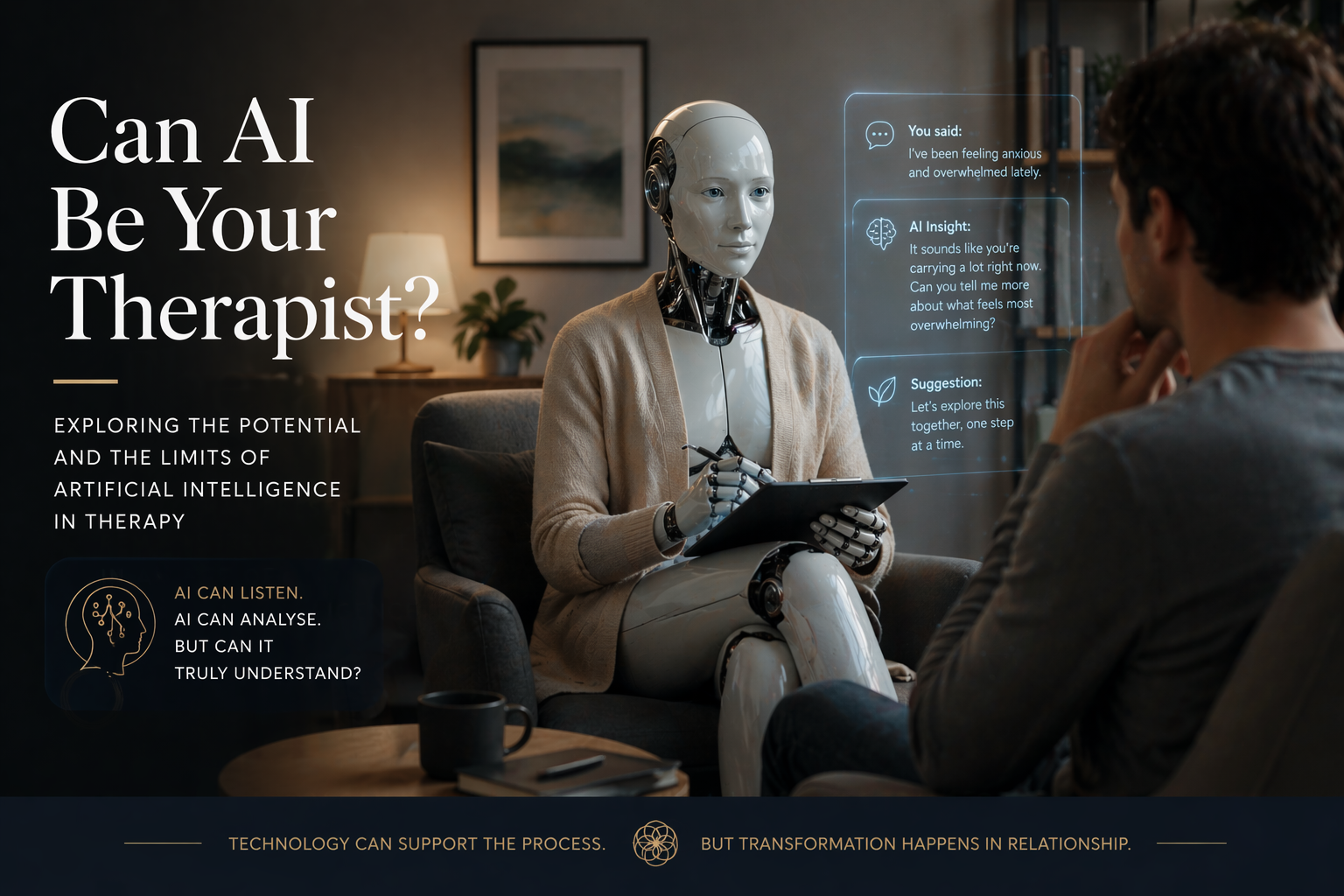
There is no question that artificial intelligence (AI) is beginning to change the landscape of therapy and personal development.
AI can offer reflection, structure, and even a form of intelligent conversation. It can help people organise their thoughts, explore patterns and gain clarity. In some cases, it can even feel supportive (perhaps even to the point of fostering delusions).
The real question about AI as a therapist
But the real question is not what Artificial Intelligence can do.
The real question is: what actually creates transformation?
Because therapy, at its deepest level, is not just about information or technique.
It is about relationship.
The benefits of a human therapist.
A well-trained therapist, particularly when trained in Integrative Psychotherapy, does not simply apply methods or follow a process. They hold a space. They meet the client with presence. And within that space, something begins to shift that goes beyond words.
In many Eastern traditions, this is understood as transmission – a real and felt quality of awareness, attention and energetic coherence that one human being brings into the interaction.
It is this that allows a therapist to respond not just to what is being said but to what is emerging in the moment.
AI can simulate dialogue.
It can mirror language.
It can even replicate certain therapeutic structures.
But it cannot sit in the room with you.
It cannot feel you.
It cannot be impacted by you.
It cannot adjust its presence in response to your nervous system, your emotional state or your deeper process of change.
And because of that, it cannot truly participate in transformation or ‘hold the space’.
Real change happens in subtle moments
Real therapeutic change often happens in subtle moments – a pause, a shift in tone, a sense of being seen or held in a way that allows something previously defended to soften.
These moments are not scripted.
They are not generated from data.
They arise from the dynamic interaction between two people.
This is where human therapy remains fundamentally different.
Artificial Intelligence may become an increasingly powerful tool. It can support reflection, offer structure and extend access to psychological insight in ways that were not previously possible.
But it does not replace the human element at the heart of meaningful change.
What is the future of AI in therapy?
In the future, the most effective approach is unlikely to be pure AI or pure human therapy.
It will likely come to encompass both.
Artificial Intelligence is supporting the process and helping structure sessions.
The human practitioner guiding, holding and responding in real time.
Because ultimately, transformation does not come from information alone.
It comes from being met, in presence, at the point where change becomes possible.